Game Theory: Smarter Decisions in Business and Life
- Rizki
- Architecture
- 04 Apr, 2022
Back in 2013, Professor Ben Polak from Yale University gave a well-known lecture on game theory.
The core idea is simple: your outcomes don’t depend only on what you do, but also on what others do.
This applies everywhere, from business and negotiations to everyday decisions.
The Key Frameworks
Polak breaks decision-making into three simple tools:
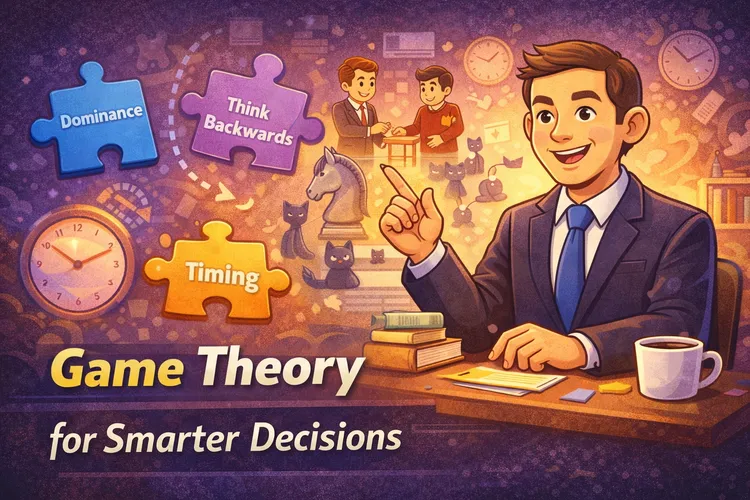
Dominance → choose what works no matter what Backward thinking → start from the end and work backwards Proactive bias → acting first isn’t always better
8 Practical Lessons
1. Most decisions are strategic
You’re almost always reacting to someone else. Competitors, teammates, even markets.
2. Timing matters as much as action
Sometimes the question isn’t what to do, but when to do it.
3. Don’t assume stronger means faster
Being “better” doesn’t always mean you should act first. Others might act early to counter you.
4. Break problems down
Big decisions get easier when you split them into smaller parts.
5. Use dominance thinking
If the same choice makes sense in every scenario, just take it.
6. Think backwards
Start from the end goal, then figure out the steps to get there. This is one of the most powerful ways to think strategically.
7. People are overconfident
Most people overestimate their abilities. That leads to bad decisions and unnecessary risks.
8. Acting fast isn’t always smart
We’re taught to “take action,” but sometimes waiting or stepping back is the better move.
The Big Idea
Good strategy isn’t just about your own skills. It’s about how your decisions interact with other people’s decisions.
The goal isn’t to act fast or aggressively. It’s to make the right move at the right time.
Final Thought
The goal isn’t to go down swinging.
The goal is not to go down at all.
Game theory is really about thinking ahead, understanding others, and choosing smarter moves, not just faster ones.